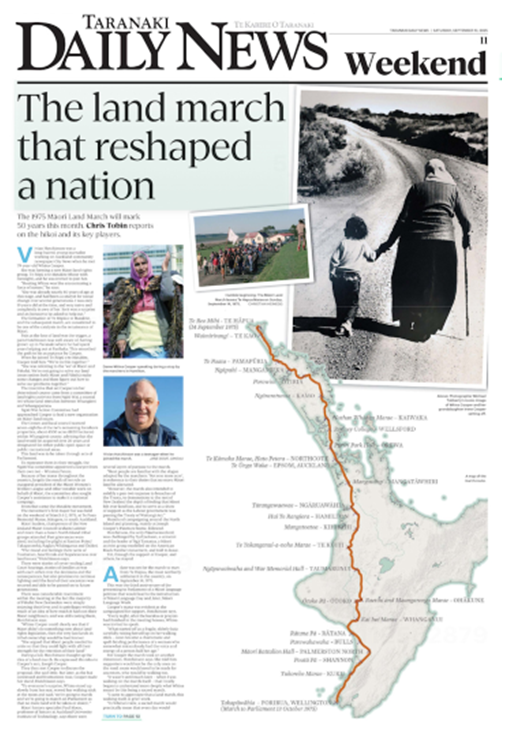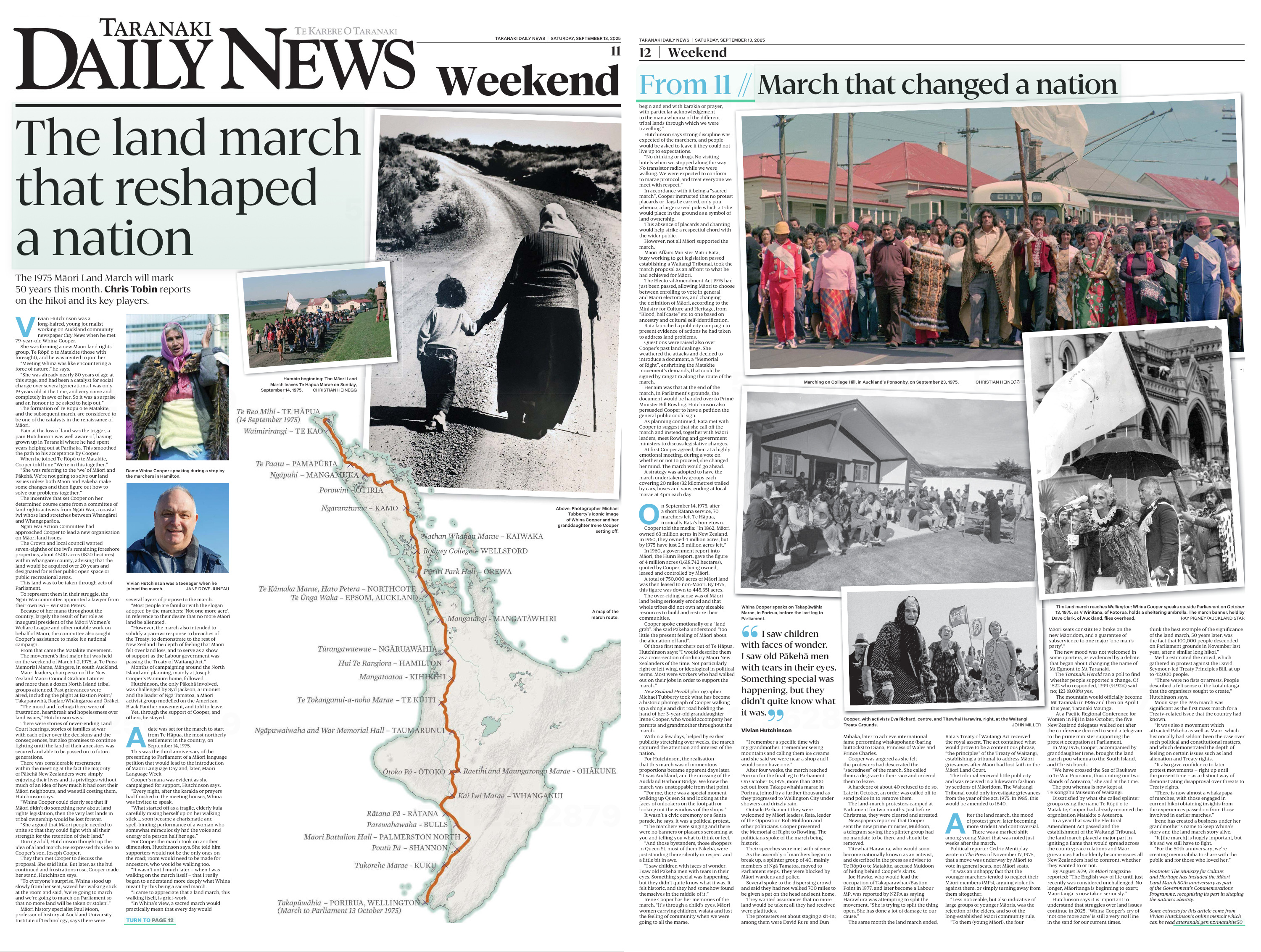
The land march that reshaped a nation
by Chris Tobin THE PRESS Saturday 13th September 2025
The 1975 Māori Land March, which reshaped Māori and Pākehā culture, will mark 50 years this month.
CHRIS TOBIN reports on the march and its key players.
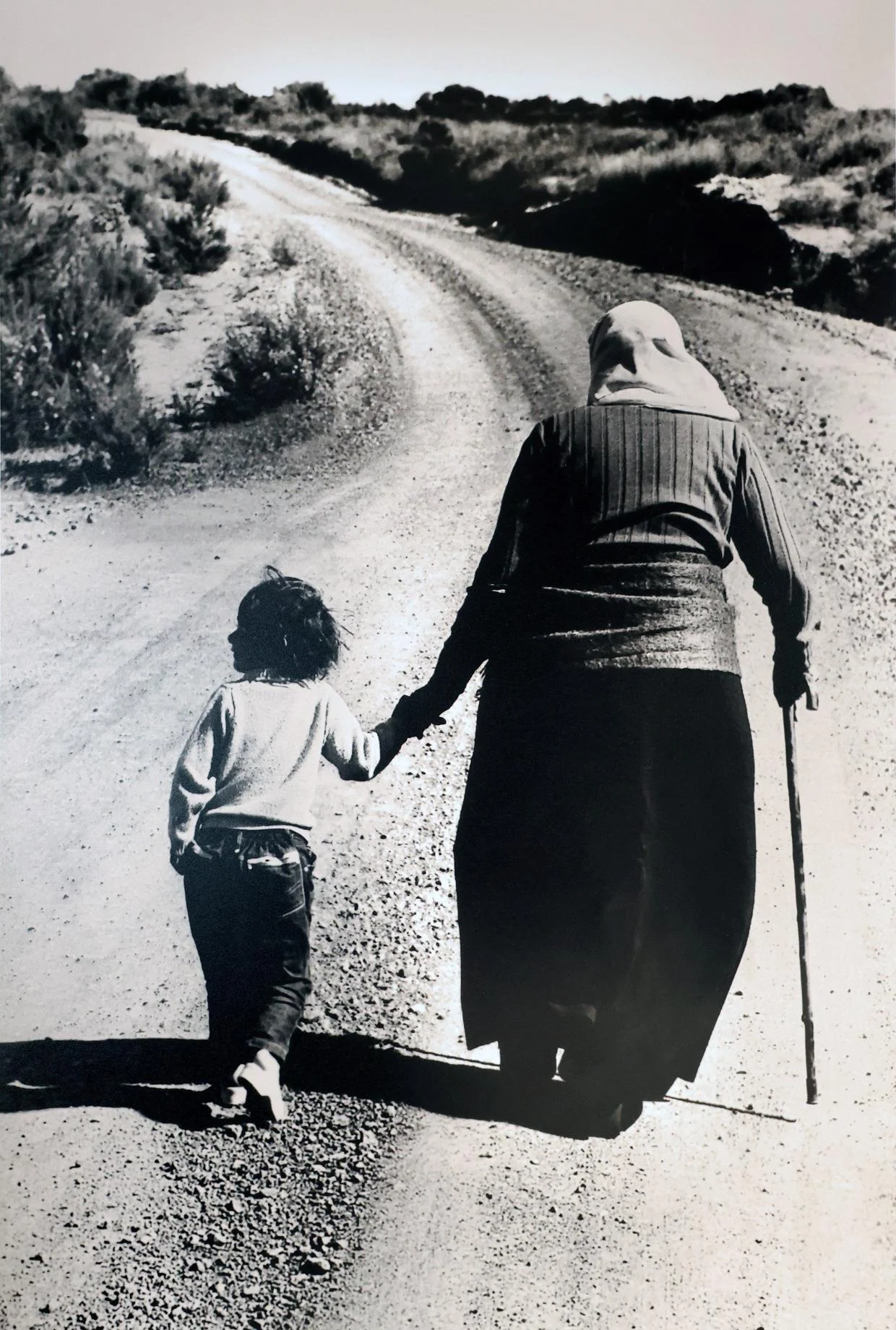
Michael Tubberty’s iconic photo of Whina Cooper and her granddaughter Irene Cooper
setting off on the march. MICHAEL TUBBERTY
VIVIAN HUTCHINSON WAS A long-haired, young journalist working on Auckland community newspaper City News when he met 79-year-old Whina Cooper.
She was forming a new Māori land rights group, Te Rōpū o te Matakite (those with foresight), and he was invited to join her.
“Meeting Whina was like encountering a force of nature,” he says.
“She was already nearly 80 years of age at this stage, and had been a catalyst for social change over several generations. I was only 19 years old at the time, and very naive and completely in awe of her. So it was a surprise and an honour to be asked to help out.”
The formation of Te Rōpū o te Matakite, and the subsequent march, are of historical significance and considered to be one of the catalysts in the renaissance of Māori.
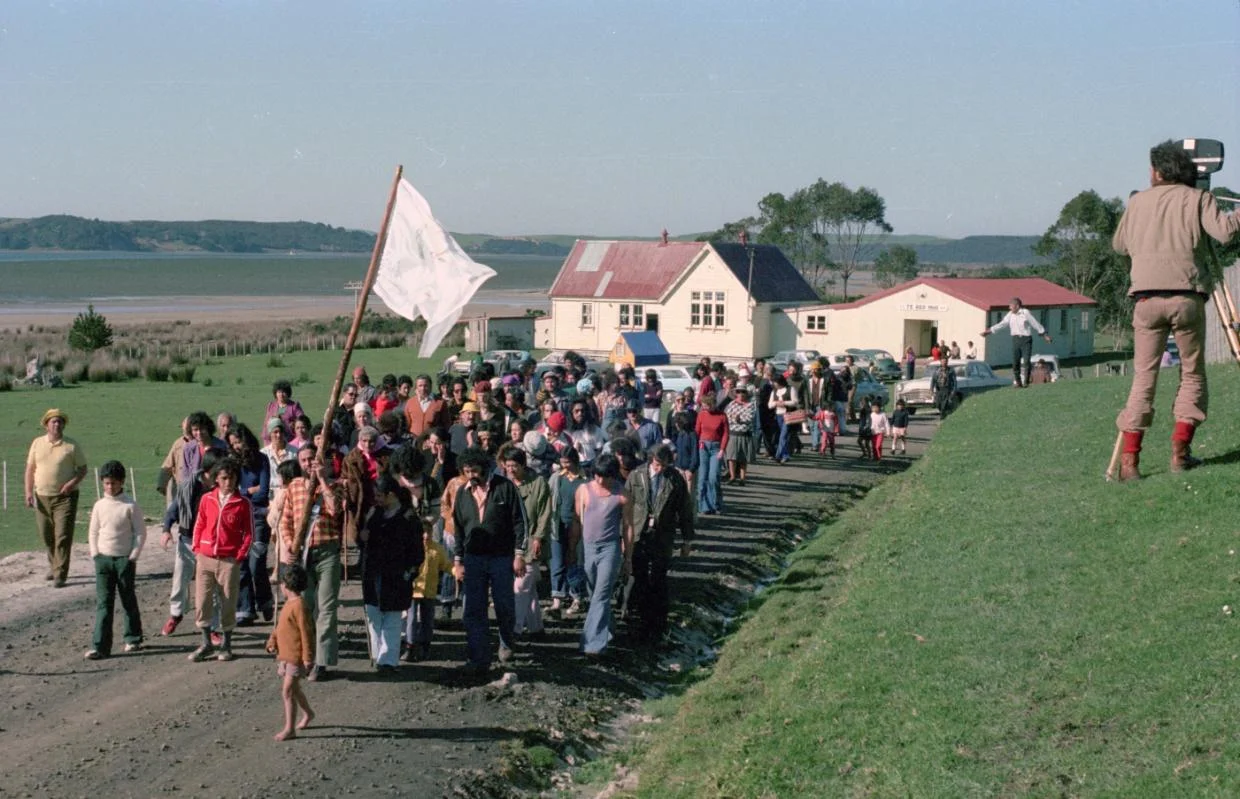
A humble beginning. The Māori Land March leaves the Te Hapua Marae
on Sunday, September 14, 1975. CHRISTIAN HEINEGG
Pain at the loss of land was the trigger, a pain Hutchinson was well aware of, having grown up in Taranaki where he had spent years helping out at Parihaka. This smoothed the path to his acceptance by Cooper.
When he joined Te Rōpū o te Matakite, Cooper told him: “We’re in this together.’’
“She was referring to the ‘we’ of Māori and Pākehā. We’re not going to solve our land issues unless both Māori and Pākehā make some changes and then figure out how to solve our problems together.”
The incentive that set Cooper on her determined course came from a committee of land rights activists from Ngāti Wai, a coastal iwi whose land stretches between Whangārei and Whangaparāoa.
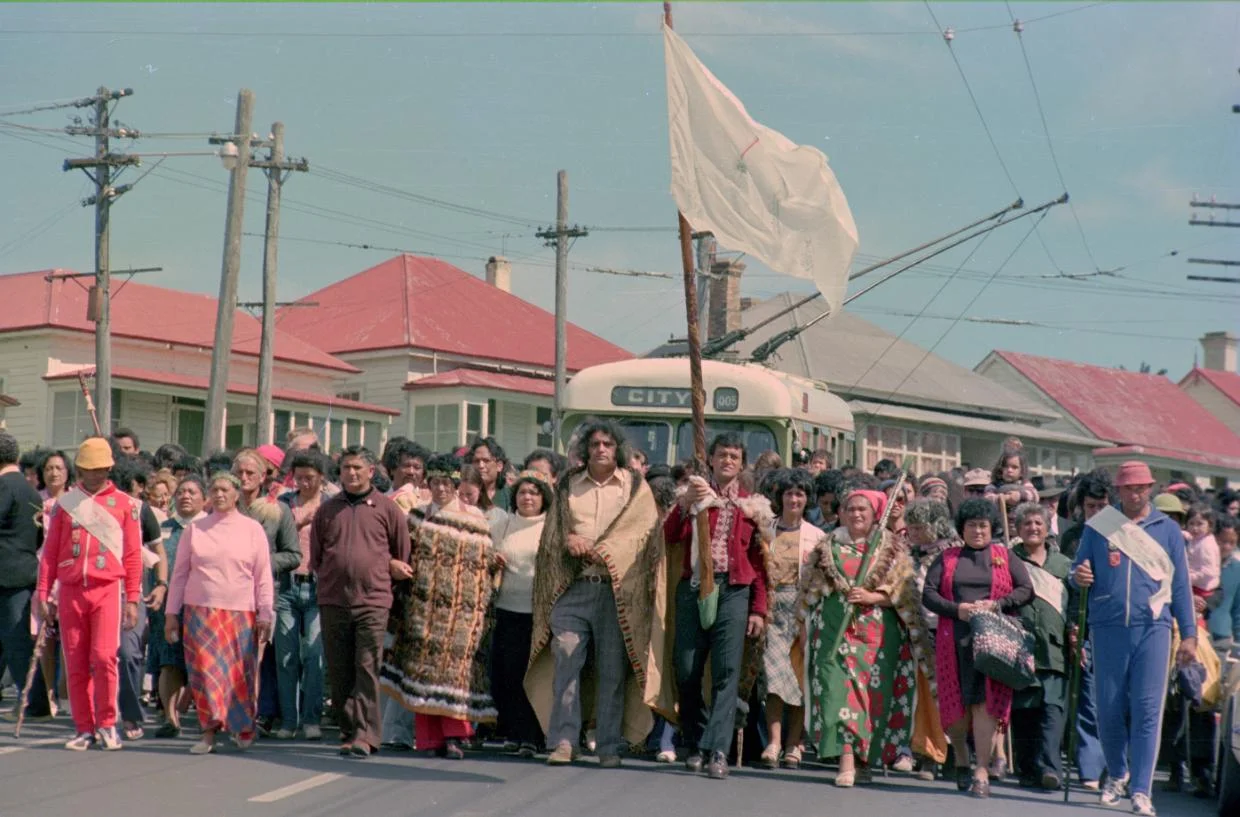
The Māori Land March on College Hill, Ponsonby, Auckland
on September 23, 1975. CHRISTIAN HEINEGG
Ngāti Wai Action Committee had approached Cooper to lead a new organisation on Māori land issues.
The Crown and local council wanted seven-eighths of the iwi’s remaining foreshore properties, about 4500 acres within Whangārei county, advising the land would be acquired over 20 years and designated for either public open space or public recreational areas.
This land was to be taken through acts of parliament.
To represent them in their struggle, the Ngāti Wai committee appointed a lawyer from their own iwi, Winston Peters.
Because of her mana throughout the country, largely for her being inaugural president of the Māori Women’s Welfare League and other notable work on behalf of Māori, the committee also sought Cooper’s assistance to make it a national campaign.
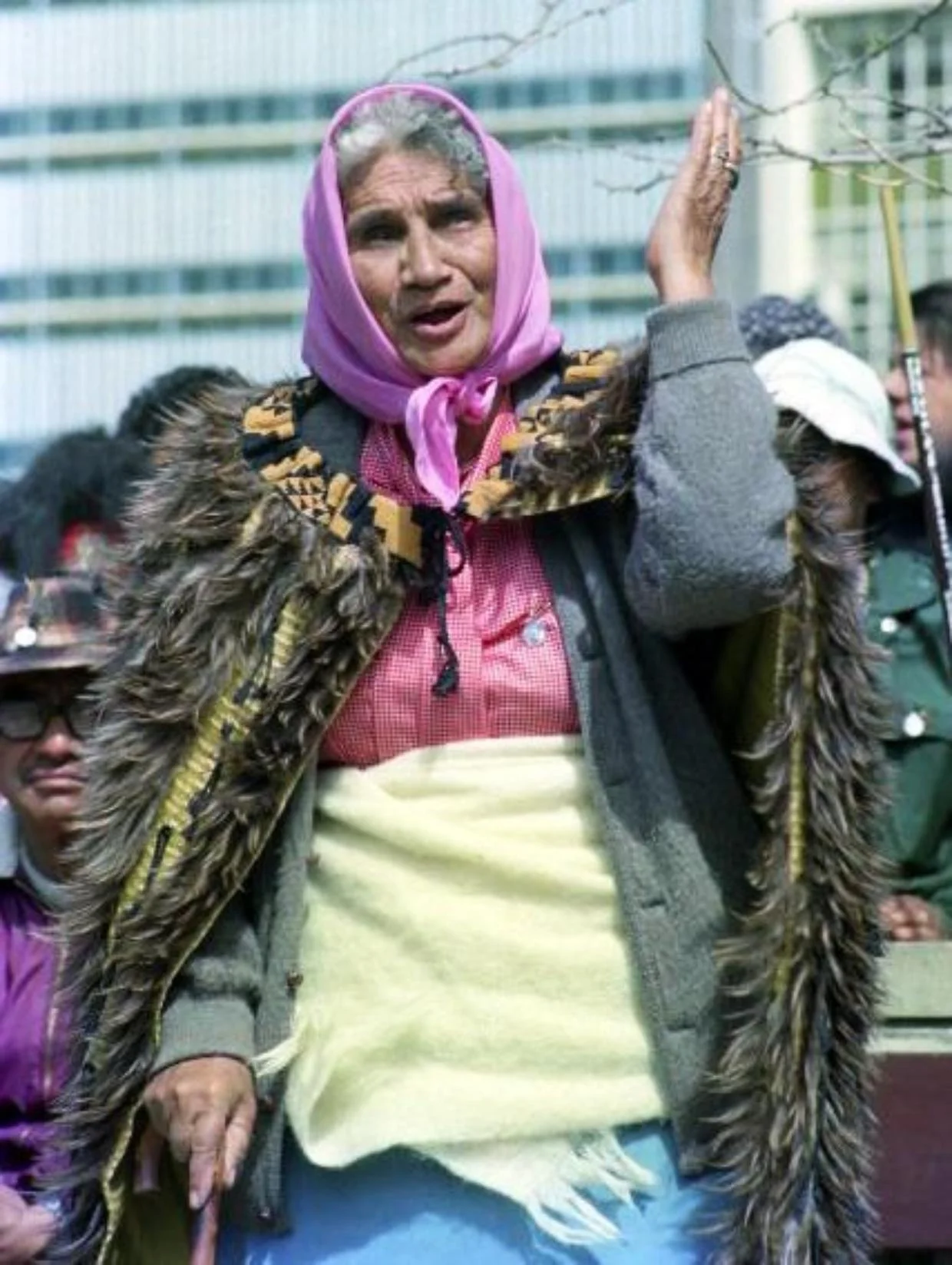
Dame Whina Cooper speaking in Hamilton
as the leader of the Maori Land March in 1975. CHRISTIAN HEINEGG
From that came the Matakite movement. The movement’s first major hui was held on the weekend of March 1-2, 1975, at Te Puea Memorial Marae, Māngere, in south Auckland.
Māori leaders, chairman of the NZ Māori Council Graham Latimer and more than a dozen North Island tribal groups attended.
Past grievances were aired, including the plight at Bastion Point/Takaparawhā, Raglan/Whāingaroa and Ōrakei.

Vivian Hutchinson was a teenager when he met Cooper
and joined the march. JANE DOVE JUNEAU
“The mood and feelings there were of frustration, heartbreak and hopelessness over land issues,” Hutchinson says.
There were stories of never-ending Land Court hearings, stories of families at war with each other over the decisions and the consequences, but also promises to continue fighting until the land of their ancestors was secured and able to be passed on to future generations.
There was considerable resentment within the meeting at the fact the majority of Pākehā New Zealanders were simply enjoying their lives and its privileges without much of an idea of how much it had cost their Māori neighbours, and was still costing them, Hutchinson says.
“Whina Cooper could clearly see that if Māori didn’t do something now about land rights legislation, then the very last lands in tribal ownership would be lost forever.
“She argued that Māori people needed to unite so that they could fight with all their strength for the retention of their land.”
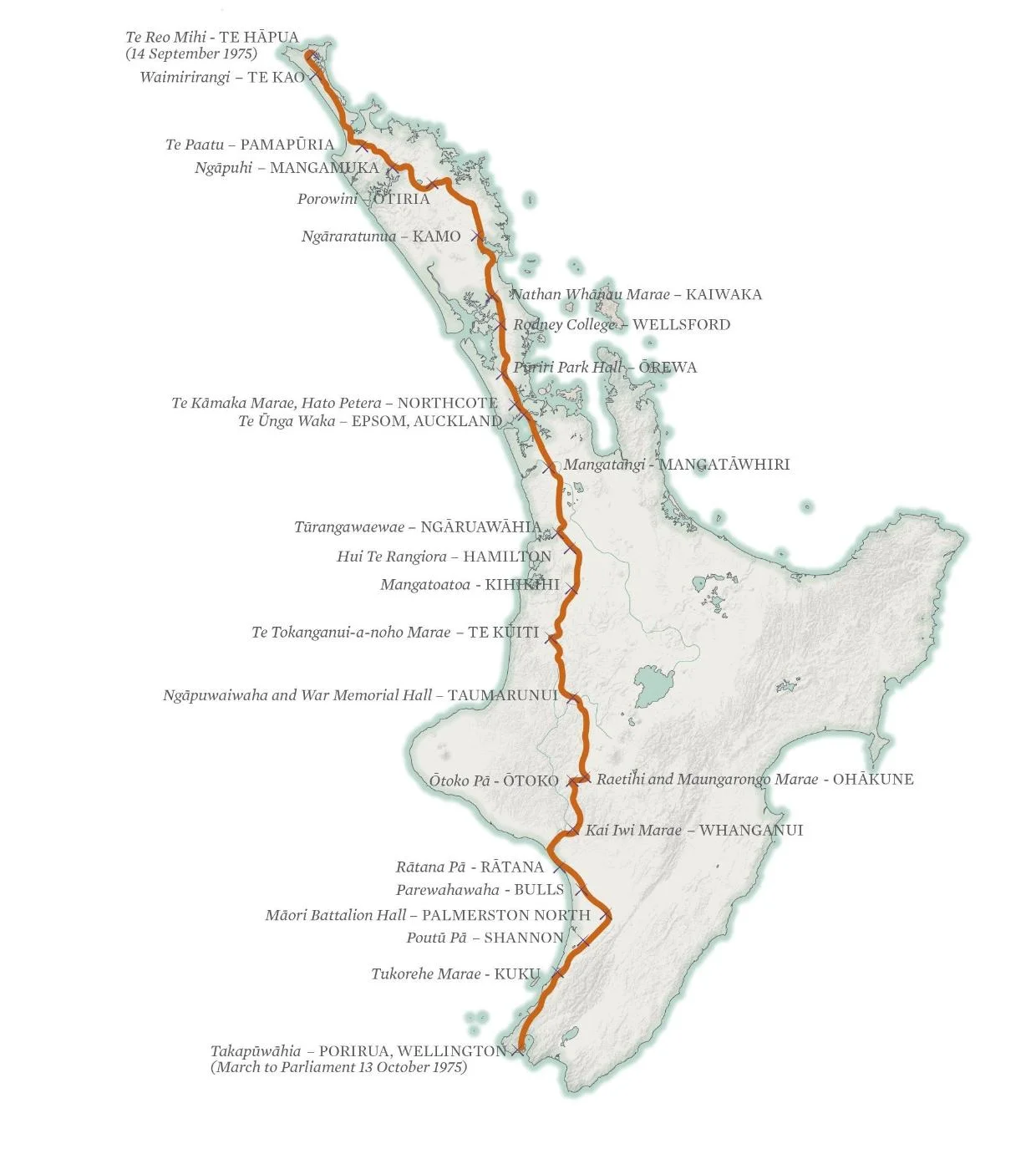
A map showing the route of the Māori Land March. NATIONAL LIBRARY
During a lull, Hutchinson thought up the idea of a land march. He expressed this idea to Cooper’s son, Joseph Cooper.
They then met with Cooper to discuss the proposal. She made little comment. But later, as the hui continued and frustrations rose, Cooper made her stand, Hutchinson says.
“To everyone’s surprise, Whina stood up slowly from her seat, waved her walking stick at the room and said, ‘we’re going to march and we’re going to march on parliament so that no more land will be taken or stolen’.”
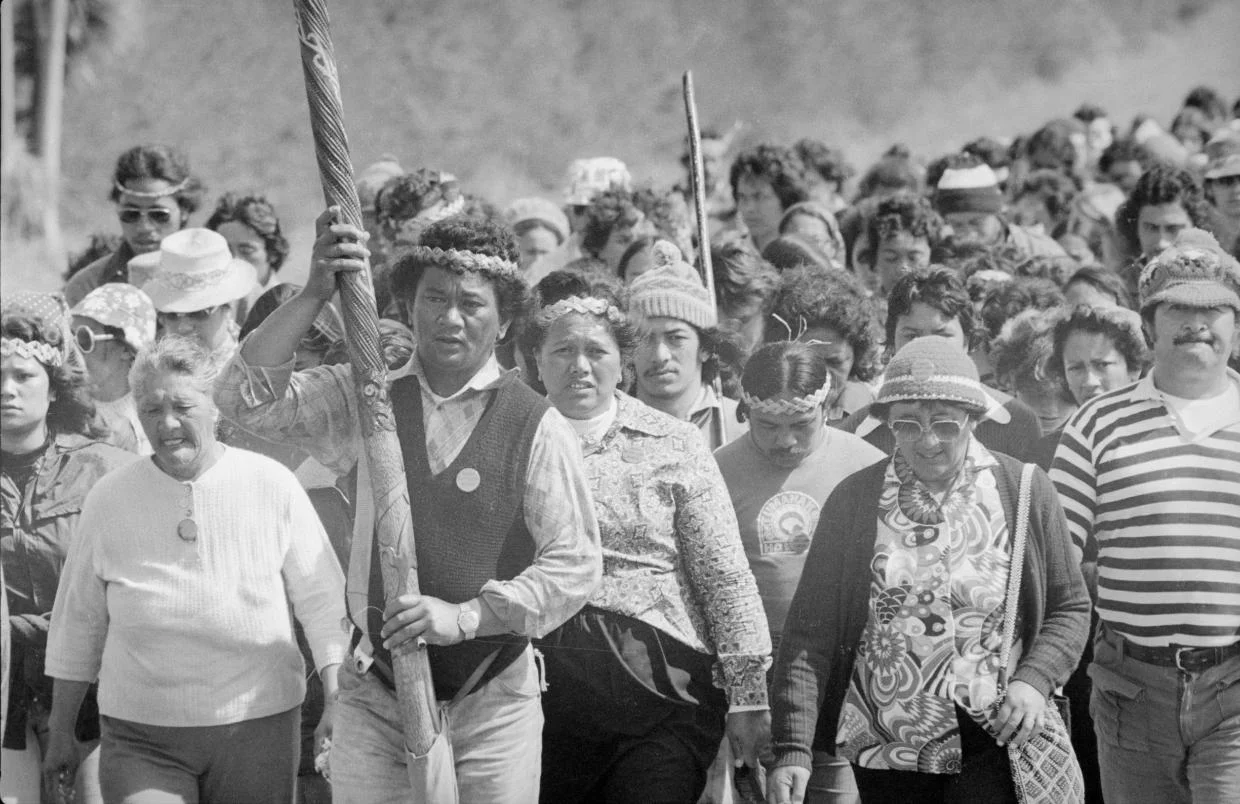
The Māori Land March heads towards Palmerston North
in October 1975. MANAWATU HERITAGE
Paul Moon, professor of history at Auckland University Institute of Technology specialising in Māori history, says there were several layers of purpose to the march.
“Most people are familiar with the slogan adopted by the marchers: ‘not one more acre’ in reference to their desire that no more Māori land be alienated.
“However, the march also intended to solidify a pan-iwi response to breaches of the Treaty, to demonstrate to the rest of New Zealand the depth of feeling that Māori felt over land loss, and to serve as a show of support as the Labour Government was passing the Treaty of Waitangi Act.”
Months of campaigning around the North Island and planning, mainly at Joseph Cooper’s Panmure home, followed.
Hutchinson, the only Pākehā involved, was challenged by Syd Jackson, a unionist and the leader of Ngā Tamatoa, a Māori activist group modelled on the American Black Panther movement, and told to leave.
Yet, through the support of Cooper, and others, he stayed.
A date was set for the march to start from Te Hapua, the most northerly settlement in the country, on September 14, 1975, the anniversary of the time three years before when a Māori language petition was presented to Parliament that would eventuate in the introduction of Māori Language Day and later Māori Language Week.
Cooper’s mana was evident as she campaigned for support, Hutchinson says.
“Every night, after the karakia or prayers had finished in the meeting houses, Whina was invited to speak.
“What started off as a fragile elderly kuia carefully raising herself up on her walking stick ... soon became a charismatic and spell-binding performance of a woman who somewhat miraculously had the voice and energy of a person half her age.”
For Cooper the march took on another dimension, Hutchinson says. She told him supporters wouldn’t be the only ones on the road, room would need to be made for ancestors who would be walking too.
“It wasn’t until much later — when I was walking on the march itself — that I really began to understand more deeply what Whina meant by this being a sacred march.
“I came to appreciate that a land march, this walking itself, is grief-work.
“In Whina’s view, a sacred march would practically mean that every day would begin and end with karakia or prayer, with particular acknowledgement to the mana whenua of the different tribal lands through which we were travelling.”
Hutchinson says strong discipline was expected of the marchers, and people would be asked to leave if they could not live up to expectations.
“No drinking or drugs. No visiting hotels when we stopped along the way. No transistor radios while we were walking. We were expected to conform to marae protocol, and treat everyone we meet with respect.”
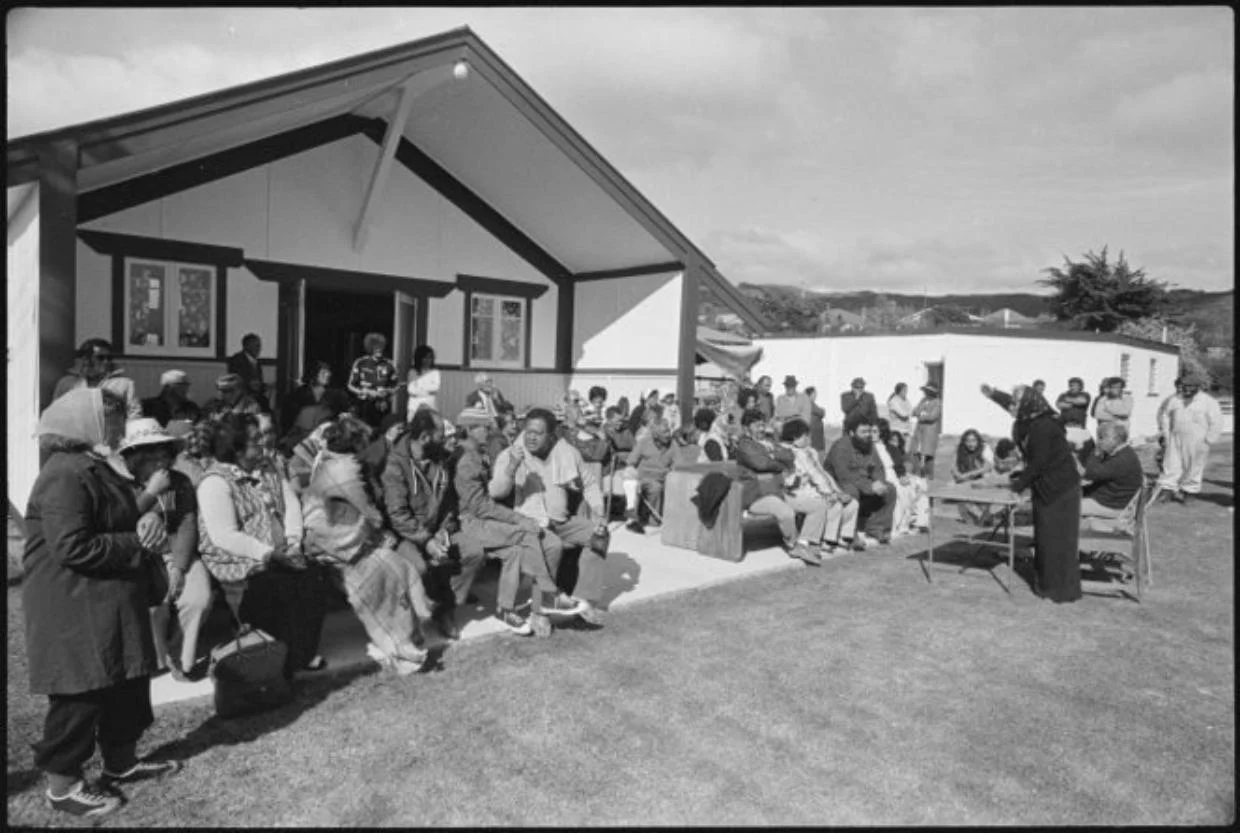
Whina Cooper speaking on Takapuwahia Marae, Porirua,
before the land march continued to Wellington. SUPPLIED
In accord with it being a “sacred march”, Cooper instructed no protest placards or flags would be carried, only pou whenua, a large carved pole a tribe would place in the ground as a symbol of land ownership.
This absence of placards and chanting would help strike a respectful chord with the wider public.
However, not all Māori supported the march.
The Minister of Māori Affairs Matiu Rata, busy working to get legislation passed establishing a Waitangi Tribunal, took the march proposal as an affront to what he had achieved for Māori.
The Electoral Amendment Act 1975 had just been passed, allowing Māori to choose between enrolling to vote in general and Māori electorates, and changing the definition of Māori, according to the Ministry for Culture and Heritage, from “Blood, half caste,” etc to one based on ancestry and cultural self-identification.
Rata launched a publicity campaign to present evidence of actions he had taken to address land problems.
Questions were raised also over Cooper’s past land dealings. She weathered the attacks and decided to introduce a document, a “Memorial of Right”, enshrining the Matakite movement’s demands that could be signed by rangatira along the route of the march.
Her aim was that at the end of the march in Parliament Grounds, the document would be handed over to the Prime Minister, Bill Rowling. Hutchinson also persuaded Cooper to have a petition the general public could sign.
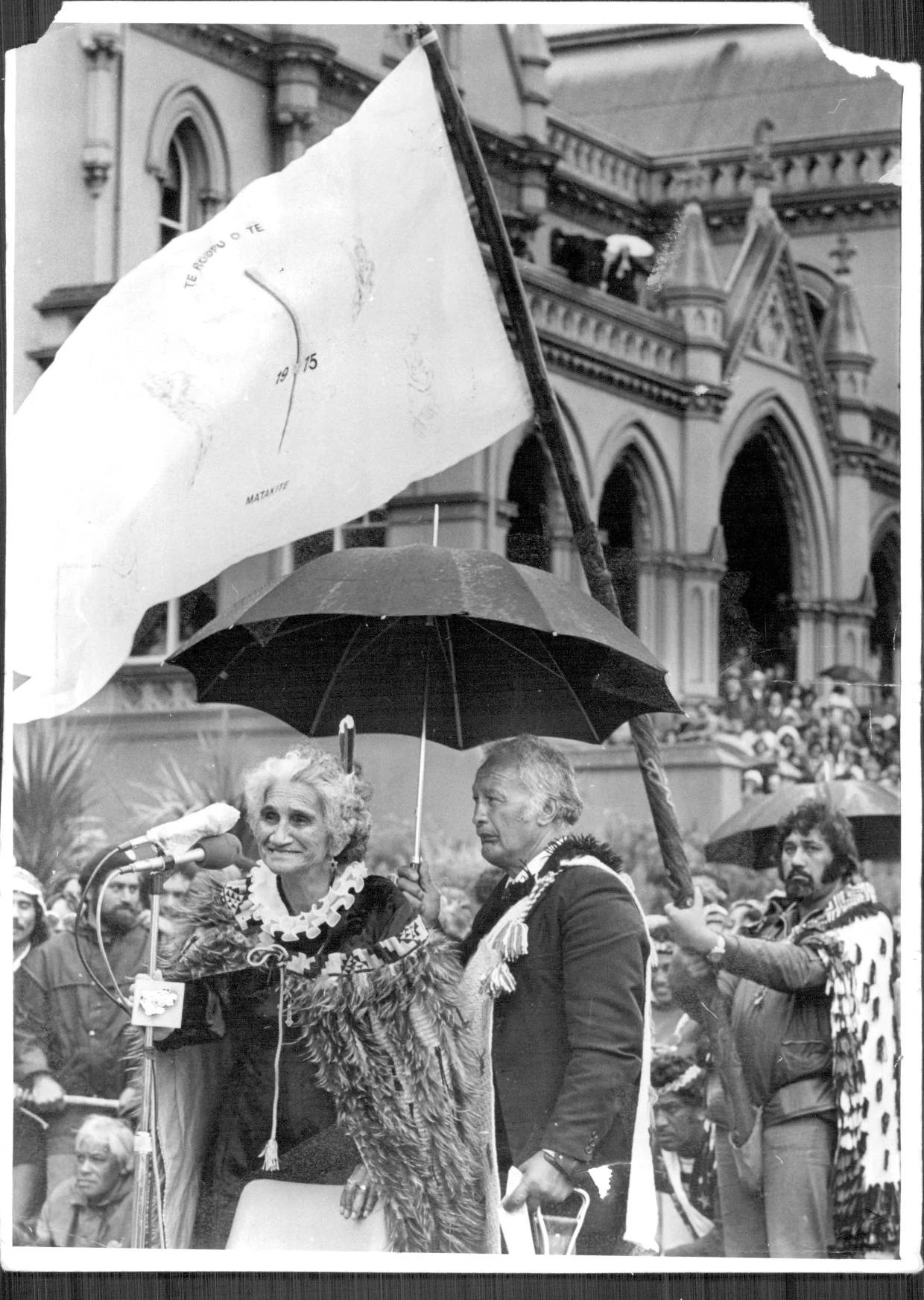
The land march reaches Wellington: Whina Cooper speaks outside Parliament,
October 13, 1975. V. Winitana, of Rotoura, holds a sheltering umbrella.
The march banner, held by Dave Clark of Auckland, flies overhead. RAY PIGNEY AUCKLAND STAR
As planning continued, Rata met with Cooper suggesting alternative action: that she call off the march and instead, together with Māori leaders, meet Rowling and government ministers to discuss legislative changes.
At first Cooper agreed, then at a highly emotional meeting as a vote was being taken on whether or not to proceed, she changed her mind. The march would go ahead.
A strategy was adopted to have the march undertaken by groups each covering 20 miles trailed by cars, buses and vans, ending at local marae at 4pm each day.
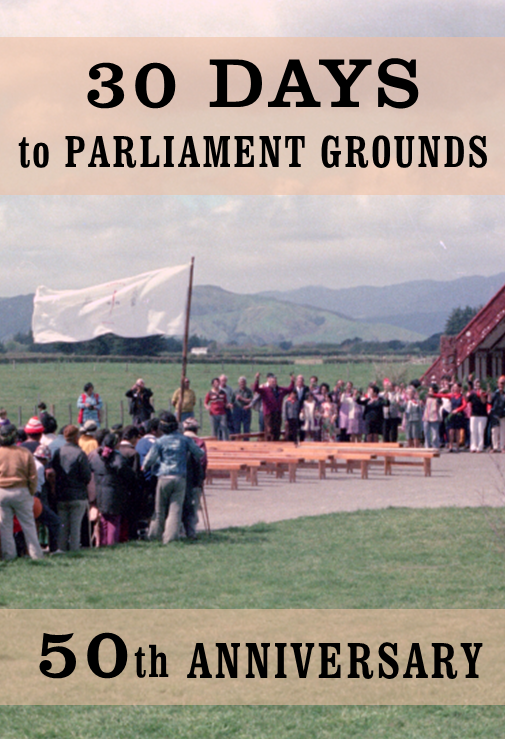
On September 14, 1975, after a short Ratana service, 70 marchers left Te Hapua, ironically Rata’s hometown.
Cooper told the media: “In 1862 Māori owned 63 million acres in New Zealand. In 1960, they owned 4 million acres, but by 1975 have just 2.5 million acres left.”
In 1960, a government report into Māori, the Hunn report, gave the figure of 4 million acres Whina quoted, as being owned, leased and controlled by Māori. A total of 750,000 acres of Māori land was then leased to non-Māori. By 1975, this figure was down to 445,351 acres.
The over-riding sense was of Māori land being seriously eroded and that whole tribes did not own any sizeable resources to build and restore their communities.
Cooper spoke emotionally of a “land grab”. She said Pākehā understood “too little the present feeling of Māori about the alienation of land”.
Of those first marchers out of Te Hapua, Hutchinson says: “I would describe them as a cross-section of ordinary Māori New Zealanders of the time. Not particularly right or left wing, or ideological in political terms. Most were workers who had walked out on their jobs in order to support the march.”
New Zealand Herald photographer Michael Tubberty took what has become a historic photograph of Cooper walking up a shingle and dirt road holding the hand of her 3-year-old granddaughter Irene Cooper, who would accompany her parents and grandmother throughout the march.
Within a few days, helped by earlier publicity stretching over weeks, the march captured the attention and interest of the nation.
For Hutchinson the realisation that this march was of momentous proportions became apparent days later.
“It was Auckland, and the crossing of the Auckland Harbour Bridge,” he says.
“We knew the march was unstoppable from that point.
“For me, there was a special moment walking up Queen St and looking at the faces of onlookers on the footpath or looking out the windows of the shops.”
It wasn't a civic ceremony or a Santa parade, he says, it was a political protest.
“The marchers were singing and there were no banners or placards screaming at you and telling you what to think or feel.
“And those bystanders, those shoppers in Queen St, most of them Pākehā, were just standing there silently in respect and a little bit in awe.
“I saw children with faces of wonder. I saw old Pākehā men with tears in their eyes. Something special was happening but they didn’t quite know what it was. It felt historic, and they had somehow found themselves in the middle of it.”
Irene Cooper has her memories of the march.
“It’s through a child’s eyes, Māori women carrying children, waiata and just the feeling of community when we were going to all the marae.
“I remember a specific time with my grandmother. I remember seeing mountains and calling them ice creams and she said we were near a shop and I would soon have one.”
After four weeks, the march reached Porirua for the final leg to Parliament. On October 13, 1975, more than 2000 set out from Takapuwhahia marae in Porirua, joined by a further thousand as they progressed to the city under showers and drizzly rain.
Outside Parliament they were welcomed by Māori leaders, Rata and leader of the opposition Rob Muldoon and other politicians.
Cooper presented the Memorial of Right to Rowling. The politicians spoke of the march being historic. Their speeches were met with silence.
As the assembly of marchers began to break up a splinter group of 40, mainly members of Ngā Tamatoa, moved to Parliament steps. They were blocked by Māori wardens and police.
Several spoke to the dispersing crowd and said they had not walked 700 miles to be given a pat on the head and sent home.
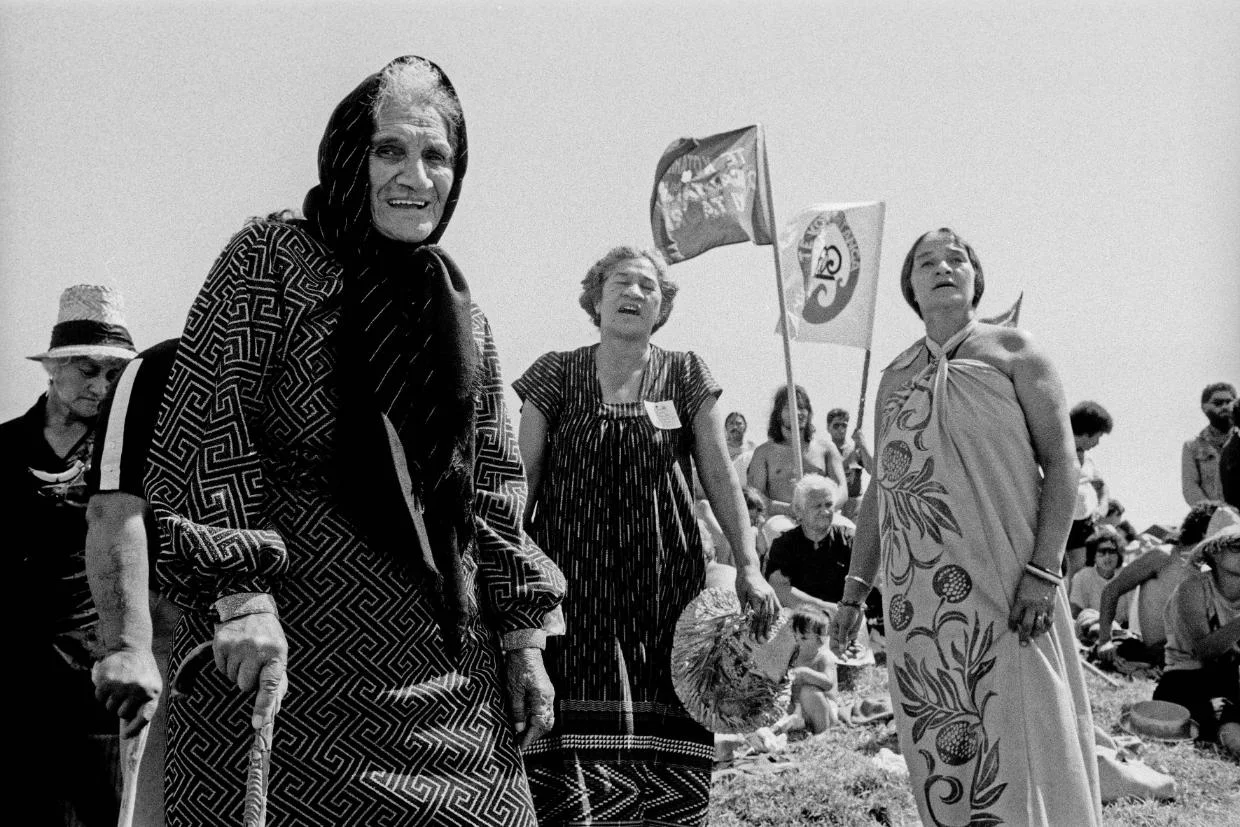
Whina Cooper, seen here with activists Eva Rickard, left,
and Titewhai Harawira at Waitangi grounds. JOHN MILLER
They wanted assurances no more land would be taken; all they had received were platitudes.
The protesters set about staging a sit-in; among them were David Ruru and Dun Mihaka, later to achieve international fame performing whakapohane (baring buttocks) to Diana Princess of Wales and Charles Prince of Wales.
Cooper was angered as she felt the protesters had desecrated the “sacredness” of the march. She called them a disgrace to their race and ordered them to leave.
A hardcore of about 40 refused to do so. Late in October an order was called off to send police in to remove them.
The land march protesters stayed camped at Parliament for two months. Just before Christmas they were cleared and arrested.
Newspapers reported that Cooper sent the new prime minister, Muldoon, a telegram saying the splinter group had no mandate to be there and should be removed.
Titewhai Harawira, who would soon become nationally known as an activist, described in the press as adviser to Te Rōpū o te Matakite, accused Muldoon of hiding behind Cooper’s skirts.
Joe Hawke, who would lead the occupation of Takaparawhau/Bastion Point in 1977, and later become a Labour MP, was reported by NZPA as saying Harawira was attempting to split the movement.
“She is trying to split the thing open. She has done a lot of damage to our cause.”
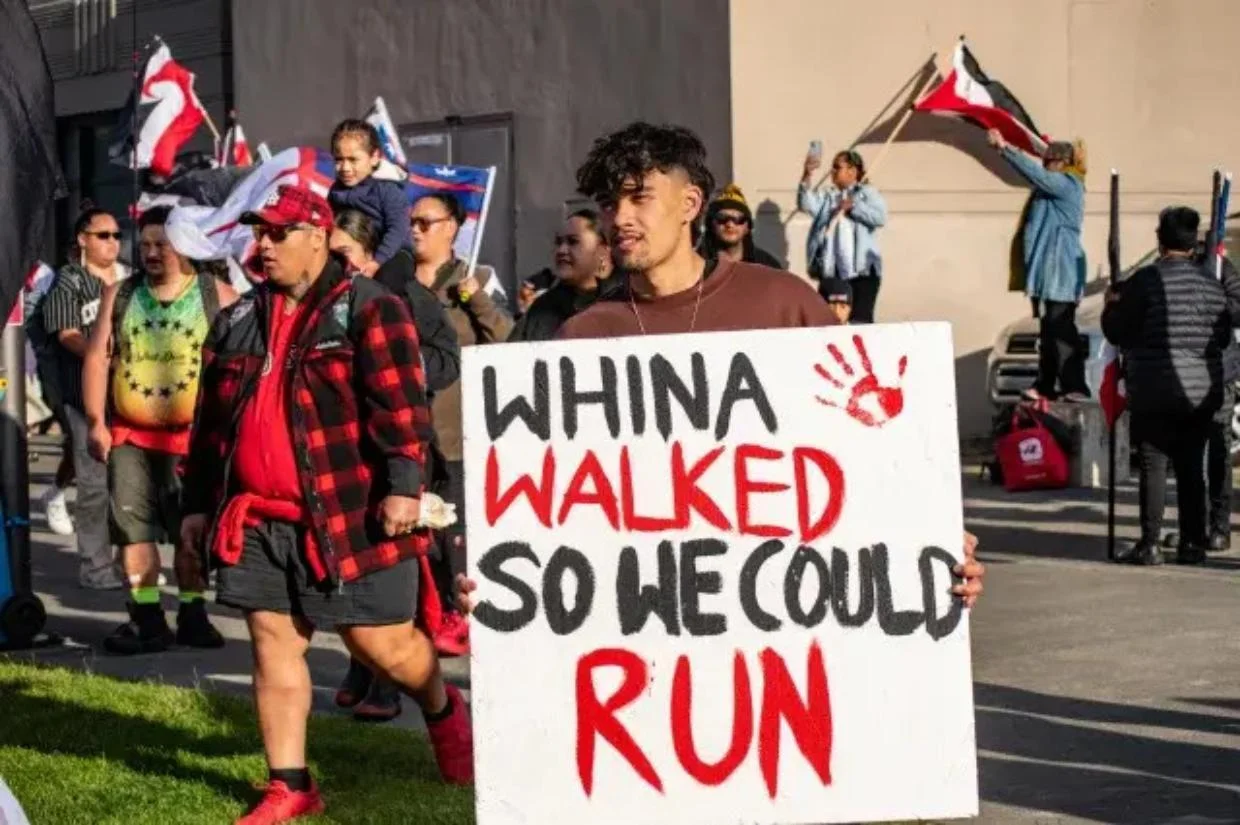
The 1975 Land March inspires a new generation. ROSIE VAN BEUSEKOM
The same month the land march ended, Rata’s Treaty of Waitangi Act received the royal assent. The act contained what would prove a contentious phrase “the principles” of the Treaty of Waitangi, establishing a tribunal to address Māori grievances after Māori had lost faith in the Māori Land Court.
The tribunal received little publicity and was received in a lukewarm fashion by sections of Māoridom. The Waitangi Tribunal could only investigate grievances from the year of the act, 1975. In 1985, this would be amended to 1840.
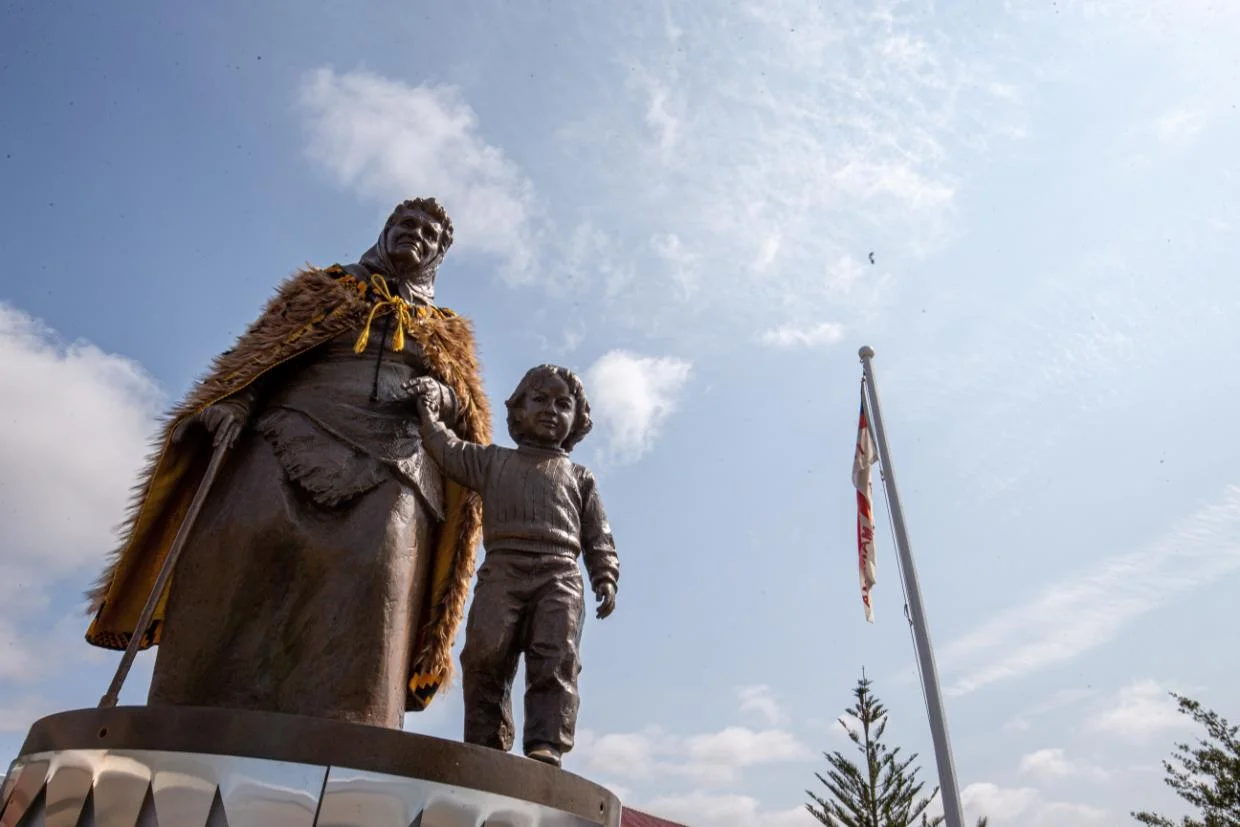
A statue of Cooper and Irene stands at Waipuna Marae
in Panguru. RYAN ANDERSON
After the land march, the mood of protest grew, later becoming more strident and controversial.
There was a marked shift among young Māori that was noted just weeks after the march.
Political reporter Cedric Mentiplay wrote in The Press of November 17, 1975, that a move was under way by Māori to vote in general seats, not Māori seats.
“It was an unhappy fact that the younger marchers tended to neglect their Māori members (MPs), arguing violently against them, or simply turning away from them altogether.
“Less noticeable, but also indicative of large groups of younger Māoris, was the rejection of the elders, and so of the long established Māori community rule.
“To them (young Māori ) the four Māori seats constitute a brake on the new Māoridom, and a guarantee of subservience to one major ‘one man’s party’.”
The new mood was not welcomed in some quarters as evidenced by a debate that began about changing the name of Mt Egmont to Mt Taranaki. The Taranaki Herald ran a poll to find whether people supported a change.
Of 1522 who responded, 1399 (91.92%) said no; 123 (8.08%) yes.
The mountain would officially become Mt Taranaki in 1986 and then on April 1 this year, Taranaki Maunga.
At a Pacific Regional Conference for Women in Fiji in late October, the five New Zealand delegates walked out after the conference decided to send a telegram to the prime minister, supporting the protest occupation at Parliament Grounds.
In May 1976, Cooper, accompanied by granddaughter Irene, brought the land march pou whenua to the South Island, and Christchurch.
“We have crossed the Sea of Raukawa to Te Wai Pounamu, thus uniting our two islands of Aotearoa,” she said at the time.
The pou whenua is now kept at Te Kōngahu Museum of Waitangi.
Dissatisfied by what she called splinter groups using the name Te Rōpū o te Matakite, she had already renamed the organisation, Matakite o Aotearoa.
In a year that saw the Electoral Amendment Act and establishment of the Waitangi Tribunal, the land march played a major part in igniting a flame that would spread across the country; race relations and Māori grievances had suddenly become issues all New Zealanders had to confront, whether they wanted to or not.
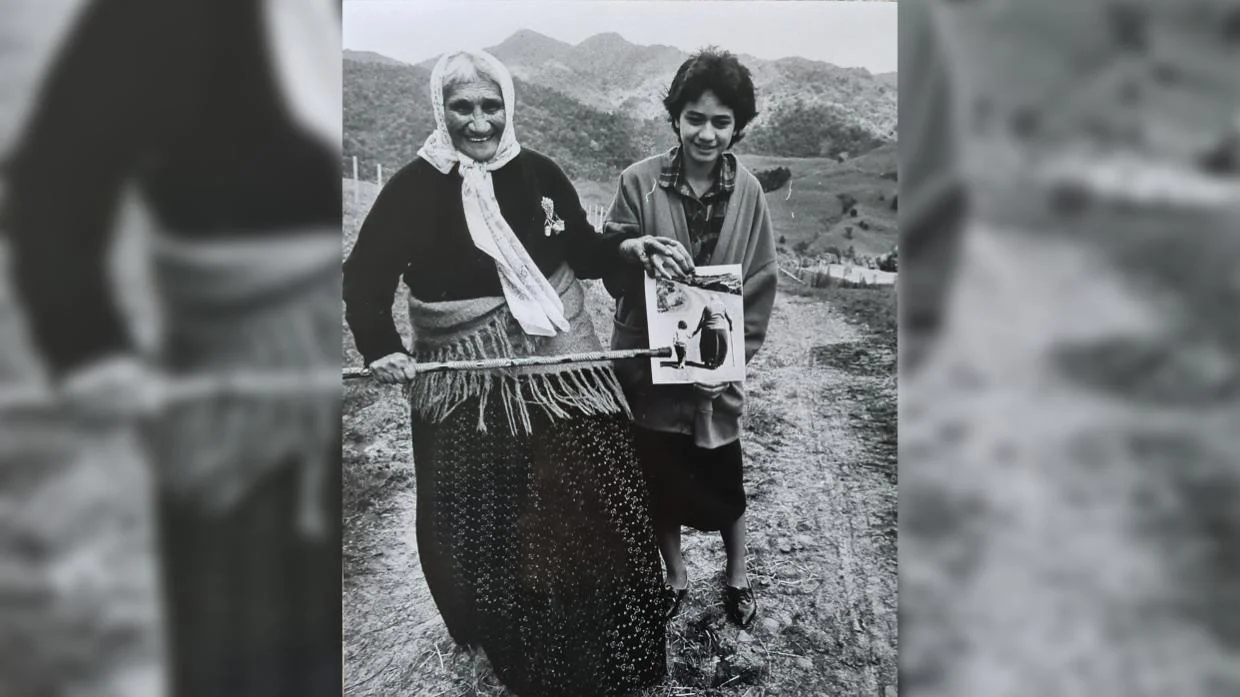
Cooper and Irene some years after the march. SUPPLIED
By August 1979, Te Māori magazine reported: “The English way of life until just recently was considered unchallenged. No longer, Māoritanga is beginning to exert; Māoritanga is now taken seriously.”
Hutchinson says it is important to understand that struggles over land issues continue in 2025.
“Whina Cooper's cry of ‘not one more acre’ is still a very real line in the sand for our current times.
“I think the best example of the significance of the land march, 50 years later, was the fact that 100,000 people descended on Parliament Grounds in November last year, after a similar long hikoi.”
Media estimated the crowd, which gathered in protest against the David Seymour-led Treaty Principles Bill, at up to 42,000 people.
“There were no fists, or arrests. People described a felt sense of the kotahitanga that the organisers sought to create,” Hutchinson says.
Moon says the 1975 march was significant since it was the first mass march for a Treaty-related issue that the country had known.
“It was also a movement which attracted Pākehā as well as Māori which historically had seldom been the case over such political and constitutional matters, and which demonstrated the depth of feeling on certain issues such as land alienation and Treaty rights.
“It also gave confidence to later protest movements – right up until the present time – as a distinct way of demonstrating disapproval over threats to Treaty rights.
“There is now almost a whakapapa of marches, with those engaged in current hikoi obtaining insights from the experiences passed on from those involved in earlier marches.”
Irene has created a business under her grandmother’s name to keep her story and the land march story alive.
“It [the march] is hugely important but it's sad we still have to fight.
“For the 50th anniversary we're creating memorabilia to share with the public and for those who loved her.”
Footnote: The Ministry for Arts, Culture and Heritage has included the Māori Land March 50th anniversary as part of the Government's Commemorations Programme, recognising its part in shaping the nation’s identity.
Some extracts for this article come from Vivian Hutchinson’s online memoir which can be read at www.taranaki.gen.nz/matakite50
✽ ✽ ✽