Unemployment
— 40 Years Ago, and Today
by vivian Hutchinson
June 2026 10 min read download as PDF
I DON'T WANT to be living in a New Zealand that has no use for such a large number of its own young people. And with joblessness for young people (under 25 years) in Taranaki currently running at one-in-five … it seems to me that we should be talking about this issue much more during this election year.
There isn’t a family in Taranaki that is raising its own children to be unemployed. We are raising our children to find their way to the good work that needs to be done.
But, in every generation, we seem to end up failing huge numbers of our young people — despite the enormous public, personal and family investments we have already made in them becoming the thriving adults we need them to be.
We've had nearly two decades of austerity measures in our communities, supported by both major political parties. These measures have included the almost complete erasure of an infrastructure of community-based initiatives designed to help unemployed young people and support them to find their way to a working independence.
Unemployment always used to be one of the top three issues cited in public surveys of what was the most urgent concern in our communities. In 2026, it is no great mystery why we are now more often talking about poverty, homelessness and food insecurity.
I'M THINKING about all this a lot lately because I am reminded that, forty years ago this week, a group of community leaders drawn from mainstream churches and service clubs in Taranaki decided to work together to address local unemployment, and in particular the unemployment of our young people.
 On 26th June 1986, they established the Taranaki Work Trust, and began one of the most comprehensive and creative programmes of community enterprise that this province has ever seen.
Through this Trust, hundreds of Taranaki people received their initial training and support which put them on a pathway to full-time employment, or starting their own businesses.
The Trust was led by four people who would now be referred to as "social entrepreneurs". They already had over a decade's worth of experience in various church-led and government-funded work schemes for the unemployed. They had also been part of the political push in the early 1980s to get community-based training and education supported as a valid pathway into paid work.
The late Wendy Heaysman led the establishment of a whole range of practical employment programmes, based at an old Christian campsite in Westown known as Willow Grove. These programmes taught skills with timber, painting and decorating, motors and light engineering, rural fencing, the care of the aged and disabled, and a life skills course for teenagers.
Meanwhile, myself, Dave Owens and Shirley Blanchard led the establishment of Starting Point, a community employment and enterprise centre, in downtown New Plymouth. There we created New Zealand's first Skills of Enterprise and Be Your Own Boss training programmes which supported unemployed people to start their own businesses, ran an Enterprise Facilitator and mentoring scheme, organised New Venture Workshops (at Bell Block), distributed a self-help Job Help guide for people who are out-of-work, and organised free advertisements in the Daily News to help unemployed people find jobs.
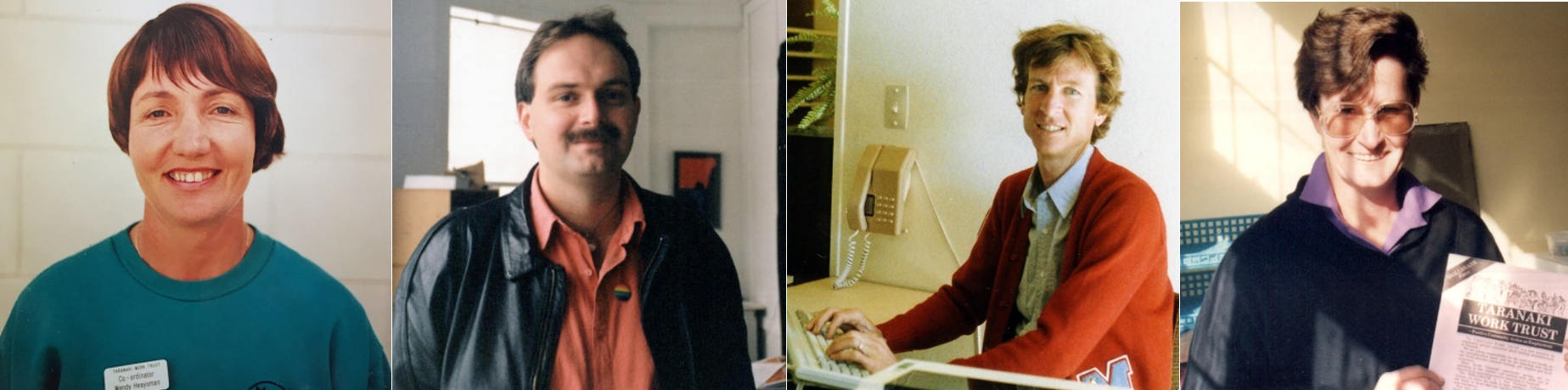
The Taranaki Work Trust Leadership Team in 1986 (left to right) Wendy Heaysman, TWT Willow Grove Training Centre Manager, former Regional Administrator of the Salvation Army Community Work Schemes; vivian Hutchinson, Taranaki Work Trust Community Adviser, former Regional Manager of the Salvation Army Community Work Schemes; David Owens, TWT Starting Point Project Adviser, former Manager of the St Andrews Community Work Scheme; and Shirley Blanchard, TWT Starting Point Manager, former Administrator of the St Andrews Community Work Scheme
These various projects of the Taranaki Work Trust were all backed by committees drawn from churches, service clubs, or other active citizens concerned about unemployment in our communities.
The funding and practical support came from government and local philanthropy ... as well as tapping into the sort of social cohesion that enabled this very diverse group of concerned citizens to work together and establish a Trust that just might make a difference.
• Taranaki Work Trust — Take a look at what was possible in just five years when a community works together to address local unemployment.
www.taranaki.gen.nz/taranakiworktrust
WHAT ULTIMATELY HAPPENED to the Taranaki Work Trust is a story for another time. Even forty years later, this is a history that depends on who you talk to.
Curiously, and perhaps even tragically ... the sort of social cohesion and community collaboration that gave rise to the Taranaki Work Trust, seems almost unimaginable in the civic and political climate of today.
But the issue of unemployment in New Zealand today is no less urgent, and deserves just as much attention.
In September 1991, there were 177,000 people officially registered as unemployed. (At this time, it was the highest rate recorded in modern New Zealand history).
Yet earlier this year, in March 2026, the current official number of unemployed people was 163,000, and rising.
We know only too well what this is meaning for our families and neighbourhoods.

Those March 2026 figures show unemployment in the New Plymouth District has now risen to one-in-five young people. That is 2,131 young people (under 25 years) not in employment, education or training.
The Stratford District is also one-in-five with 279 young people affected.
Hawera and the South Taranaki District is up to one-in-four with 889 affected.
That's a total of 3,299 young adults in Taranaki who are not in employment, education or training. This provincial figure is much greater than the combined number of students currently enrolled in both the New Plymouth Boys’ and the New Plymouth Girls’ High Schools.
And these figures do not reflect the large numbers of local young people (we all know about) who have gone overseas to look for work!


statistics courtesy of the Mayors Taskforce for Jobs.
For other regions see mtfj.co.nz/youth-employment-dashboard.
The fact that there is not widespread outrage at these figures is itself part of the problem. The public willingness to accept such a high level of unemployment could well be an outcome of the darker arts of public policy and neo-liberal political management.
I’m old enough to remember that our first modern work schemes were created at a time when just 50,000 officially unemployed people was considered a national emergency.
But, over the last 40 years, unemployment has been largely redefined in the public mind as some sort of personal issue. A young person's individual struggle to find a job is too often considered a problem of their own making.
And the more recent austerity measures seem to have convinced most politicians and community leaders that there is very little that they can really do about it.
BUT LET'S GET things in perspective. The main personal problem that our one-in-five young people have got is the fact that they are suffering the consequences of our national economic policies. And those same policies are also holding back our national creative abilities to really do something about it.
Last year, the public academic Max Rashbrooke, and the IDEA Think Tank, released an independent report on the state of jobs and workforce planning in New Zealand. This report pointed out that the amount being spent on training and support measures for the unemployed in New Zealand is about half of that being spent by our major trading partners in the OECD.
This collective level of disinvestment in the real needs of our young and unemployed is just shameful. And, in an election year like this, there should be much more of a public conversation about these choices.
After two decades of our communities “tightening our belts”, we are well past the time when we need to regain the political commitment to ensure that all our young people get the support they deserve.

cartoon illustration by Mike Ward from the “Job Help” booklet (1985) distributed by the Starting Point community employment resource centre in New Plymouth
THE SEARCH FOR SOLUTIONS to unemployment requires us to remember our recent histories, draw from what we can learn from these experiences, and keep stretching our imagination of just what is possible. The establishment of the Taranaki Work Trust, 40 years ago, certainly showed us what we were capable of.
This coming Friday, also on the 26th June, there will be a conference in Wellington examining the “polycrisis” affecting New Zealanders and our communities. Perhaps it is also well-timed for an election year.
The “Reality of Everything” Symposium is a one-day event bringing together leading experts to lay out what is happening in the areas of climate change, biodiversity loss, energy challenges, food security, public health, and our democracy itself. The goal of the Symposium is to help build the foundations for informed, collective action.
However we face these important and inter-woven issues, we will need all our young people engaged in the solutions. And let's state the obvious: with such a “polycrisis” staring us in the face, there is plenty of work that needs to be done!
Now is the time we should be investing in the good work that our young people are very capable of stepping up to — addressing how we can look after one another better, and restoring and regenerating the earth which is our common home.
vivian Hutchinson
21 June 2026
vivian Hutchinson QSM was one of the founders of the Taranaki Work Trust, and former editor of “The Jobs Letter”. He is also the author of “How Communities Heal” (2012) and “How Communities Awaken” (2021). For more information, see www.taranaki.gen.nz/vivian
This article is published to the Commons. It is is licensed for distribution under a Creative Commons Attribution-Noncommercial 3.0 New Zealand License http://creativecommons.org/licenses/by-nc/3.0/nz/deed.en