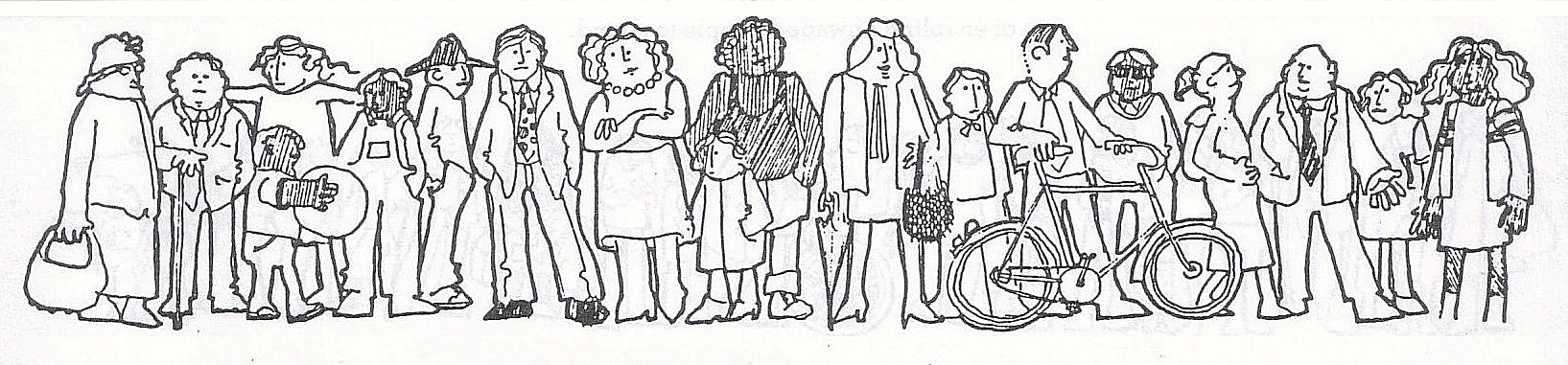
The Festivals of Co-operation were held at the Tauhara Centre in Taupo, New Zealand from 1985-1988. These gatherings sought to “… celebrate the ways that New Zealanders can work together”.
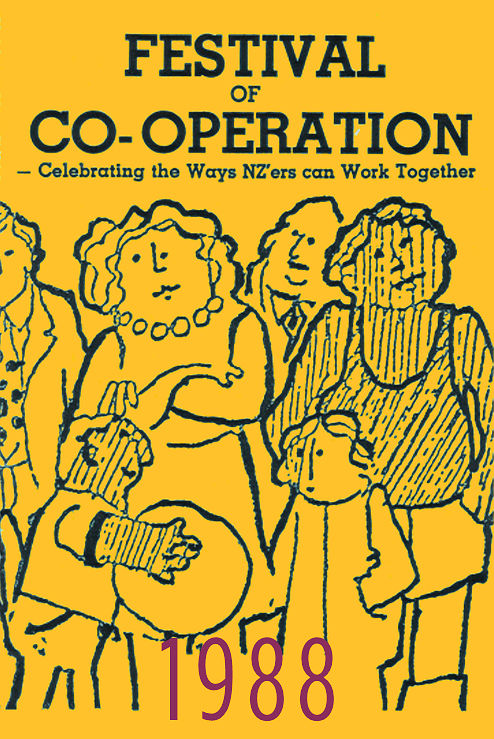
These were the mid-80s when many community activists throughout New Zealand were trying to get to grips with the Great Betrayal of the Labour Party, and the consequences of neoliberal Rogernomics. Suddenly, our communities were facing growing unemployment and a widening gap between rich and poor. And there were worsening environmental issues that we needed to address.
Roger Douglas and Maggie Thatcher, and the other political leaders of the time, had a slogan of "There is No Alternative" (or TINA, for short). Ours was "There are Many Alternatives" (or TAMA). In gatherings such as these Festivals, we wanted to shine a light on the many other possibilities for community action and regeneration that we were also trying to create.
✽ ✽ ✽
The aim of our gathering was to bring together the scattered threads of an emerging co-operative movement in New Zealand, share our stories and skills, and "celebrate and affirm the spiritual and philosophical roots of co-operation".
Participants were variously involved in worker co-operatives, food co-ops, consumer co-ops, housing co-ops, co-operative banking and co-operative schools.
There was an emphasis on the philosophies of the British Economist E.F.Schumacher, author of "Small is Beautiful", who was proposing an economics "...as if people mattered".
The Festivals of Co-operation also held training sessions on how groups could become more effective. Popular workshop titles included "Ground Rules for Group Life", "Running Co-operative Meetings" and "How to Fight and Still Be Friends".
✽ ✽ ✽
We adopted the Rainbow flag as a symbol for our gatherings, because the international co-operative symbol at that time was the rainbow, as it had been since 1925. The colours represented the co-operative principles of this international movement, and it was also a visual symbol of "unity within diversity". (San Francisco gay activists adopted a similar rainbow symbol for their Pride flags in 1978, which quickly became more prominent in the media and public consciousness).
✽ ✽ ✽
Many of these more youthful faces in these albums are no longer with us, and the children may now have families of their own ... but dozens of the people pictured have gone on to make exceptional contributions to New Zealand today — creating community organisations, working as public and civil servants, standing against the extractions and abuse taking place in our environment and our society, serving in local and national government, honouring Te Tiriti o Waitangi, building peace and reconciliation between peoples, or just bringing the leadership of kindness and creativity to their own neighbourhoods.
✽ ✽ ✽
In the forty years since the Festivals of Co-operation, there has been much more scientific research that reveals the evolutionary roots of humankind and shows that we are hard-wired for co-operation rather than competition. This is contrary to what the neo-liberal economists have been trying to convince us of over the last two generations.
The Dutch historian and author Rutger Bregman has summarised much of the research in his 2020 book “Humankind: A Hopeful History”. This research challenges the traditional belief that humans are inherently selfish and aggressive, and suggests instead that kindness, empathy, and altruism are our default settings. Bregman argues that our “secret superpower” is not raw strength or individual cunning, but our ability to build trust and work together. Perhaps we need more Festivals that simply celebrate this common sense. For more see http://youtu.be/TXN7QGGNSWk
✽ ✽ ✽
After four years of Co-op gatherings, many of the core people involved in organising the Festivals of Co-operation went on to create Heart Politics, another series of gatherings which were also held at the Tauhara Centre every six months for the next twenty years. Heart Politics also brought together a very diverse community of active citizens who have been working throughout New Zealand in social, economic, environmental and cultural fields.