
25 Years of Mayors and Jobs
— some continuing thoughts on full employment
by vivian Hutchinson
July 2025
25 YEARS AGO, the Mayor's Taskforce for Jobs was launched in Christchurch by local Mayor Garry Moore. Within a few months, all Mayors in New Zealand – except two - had joined, which was something that had never happened before in the history of local government.
In creating the Taskforce, the Mayors had come together on what was normally considered a national social and economic issue. But their intention was to create a fresh focus of leadership on the question of unemployment that was affecting their communities.
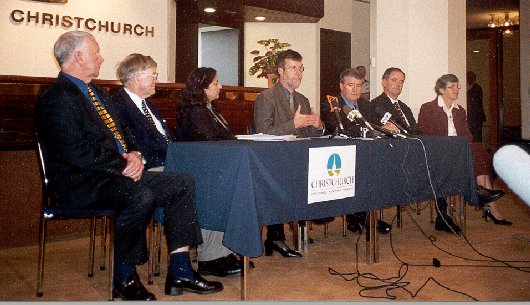
Launch of the Mayors Taskforce for Jobs, Christchurch, 6-7 April 2000
(left to right) Alan Dick (Napier), John Chaffey (Hurunui), Sukhi Turner (Dunedin), Garry Moore (Christchurch), Jim Anderton (Minister of Economic Development), Russ Rimmington (Hamilton), and Jill White (Palmerston North)
A YEAR before the Taskforce was launched, I had been asked to speak in Christchurch at a meeting of district councils and local authorities on community governance issues. I was there at the invitation of Garry Moore, with whom I had supported many community employment initiatives throughout New Zealand.
It was during my speech that I asked the Mayors who were present to come together and form a Taskforce for Jobs. I believed that local government needed to “walk the talk” in terms of the different leadership roles it could take — particularly in the way that it can listen to the people who have been left behind, and how it can bring groups together to better address our major public problems.
At the time, seven Mayors immediately stood up in the audience and said: “Yes, we are going to do it!” These Mayors included Garry Moore (Christchurch), Derek Fox (Wairoa), Sukhi Turner (Dunedin), Jenny Brash (Porirua), John Chaffey (Hurunui), Tim Shadbolt (Invercargill) and Jill White (Palmerston North). They became the core group which drove this new initiative.
✽ ✽ ✽
RIGHT FROM the very start, there were plenty of council and government policy advisers who cautioned the Mayors against the Taskforce proposal. Essentially, the Mayors were being told to “stay in their lane” and not get involved in a national social and economic issue.
I’m thankful that this core group of Mayors made up their own minds on the matter. I even got to work alongside the Mayors Taskforce, as its “Community Adviser” for the next seven years. During that time we worked around the country starting up cadetships and apprenticeship schemes in councils to employ young people, creating schemes to track young people once they left school, holding graduation ceremonies for apprentices in order to boost the profile of the trades at a time of skill shortages, building some surprising partnerships with business and union leaders, and also regularly meeting with government departments and government ministers in order to create plans that had the goal of every young person in New Zealand being in either work or education.
We had some successes, and some failures, and established some unlikely collaborations. And the Mayors, from the North Cape to Bluff, created connections and championed possibilities that have led thousands of young people into employment, and to a fuller participation in their communities.
The interesting thing for me was that the Mayors and I were able to work well together even though our political persuasions were often very different. I was obviously seen as some sort of democratic socialist, and many of the Mayors in the network had held what I considered to be extremely right-wing views.
But we came together around the issue of “jobs”. We immediately found common ground in that none of us wanted to be living in a country that had no use for a large number of its own young people.
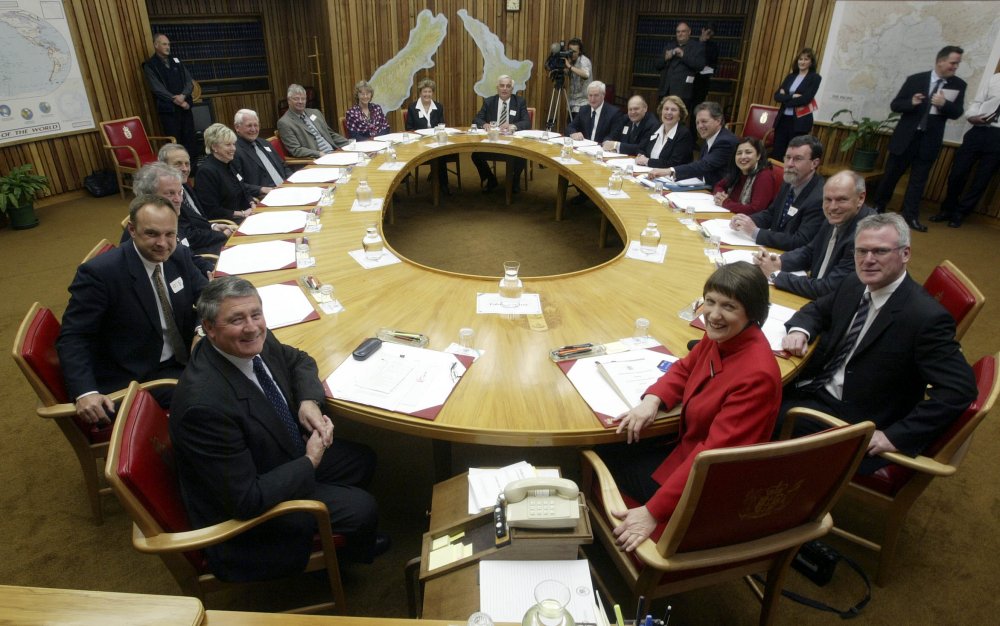
Mayors at the Cabinet Table, the Beehive, 2nd October 2002, where the Mayors Taskforce signed a Memorandum of Understanding with the Labour Government to work towards the shared goal that all 15-19 year olds in New Zealand would be engaged in work, training or education by 2007.
(clockwise from bottom) Jim Anderton (Minister of Economic Development), Graeme Ramsey (Kaipara), Chris Lux (Thames-Coromandel), David Braithwaite (Hamilton), Sue Morris (Ruapehu), Gordon Blake (South Waikato), Eric Tait (Otorohanga), Jenny Brash (Porirua), Yvonne Sharp (Far North), Paul Matheson (Nelson), Pat O'Dea (Buller), Kevin Brown (Grey), Frana Cardno (Southland), Tim Shadbolt (Invercargill), Sukhi Turner (Dunedin, Deputy Chair of Taskforce), Garry Moore (Christchurch, Chair of Taskforce), Chris Carter (Minister of Local Government), Steve Maharey (Minister of Social Services and Employment), and Helen Clark (Prime Minister).
FULL EMPLOYMENT was one of the great political and cultural achievements of the post-World War II generation, and it was a mainstream political goal that our nation had struggled towards for most of the first half of the 20th century. This is why one of our major political movements that emerged at that time named itself after our ability to make a contribution through our work.
The post-World War II generation knew that our communities are based on livelihood. These people also understood that the best social security and welfare policies are those that are anchored in full employment policies. Unemployment wasn’t seen as just an economic and social issue — it was a governance issue. For the post-World War II generation, creating a culture of full employment was considered part of the art of governance ... regardless of your political stripes.
But somehow, in the most recent generation, we have lost not only the political commitment, but also our cultural commitment to full employment policies. The neo-liberal doctrines that had taken over both our National and Labour governments have steadily and successfully chipped away at the social contract that had been woven into our civil intentions and our economics.
✽ ✽ ✽
MY ADVOCACY in the Mayors Taskforce for Jobs was to speak for the cultural purpose of full employment. This meant having the political and practical commitment to ensure that noone is left behind.
I was not romantic about the idea of a social contract. I didn't believe that we could go back to the era of the 1950s and 1960s, and the solutions we were seeking should never be seen as simplistic as that. But I was saying, as we moved forward, that we were going to have to rediscover a fresh commitment to what full employment meant in the new millennium.
This commitment was what essentially lay behind the “Task” that the Mayors Taskforce had set itself — “that all young people under 25 years be in paid work, in training or education, or in useful activities in our communities.”
The paradox of unemployment is that we are surrounded by an abundance of good work to do. Much of this work is pressing and urgent in our communities, or in our environment, and we would all be much better off if this work was done. Like the unemployed themselves, much of this work is simply waiting to be valued.
Beyond our usual notions of economic development, there are two sectors with enormous potential for fuller employment. The first sector contains all those jobs that come from choosing to look after one another better. The second sector contains those jobs that come from choosing to look after the earth better.
These sectors are not driven simplistically by market desire. They are driven by the governance choices that communities make through their leaders, and local leaders such as our Mayors.
The jobs are there. We simply need to choose to value them and value our investment in the people that can do them.
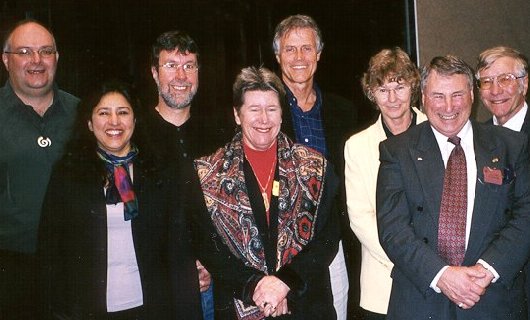
Mayors from the Taskforce for Jobs meeting with the American businessman, environmentalist and author Paul Hawken in Christchurch 27 June 2000 during the "Redesigning Resources" conference of business, government, science, arts and community leaders. (from left to right) vivian Hutchinson (Mayors Taskforce Community Adviser), Sukhi Turner (Dunedin, Mayors Taskforce Deputy Chair), Garry Moore (Christchurch, Mayors Taskforce Chair), Claire Stewart (New Plymouth), Paul Hawken, Jenny Brash (Porirua), Michael McEvedy (Selwyn), and John Chaffey (Hurunui).
I WROTE a series of speeches during the seven years that I was involved with the Mayors Taskforce for Jobs. https://www.taranaki.gen.nz/advicemtfjobs It is interesting for me to re-read them now, and appreciate the economic and social transformation that has unfolded in the last 25 years, and how quickly the sense of what matters in our communities has changed.
As the Editor of The Jobs Letter, I used to publish a regular scoreboard of national and regional unemployment figures called Statistics That Matter, which was based on the three-monthly surveys of Statistics New Zealand. Those same surveys are now telling us that there are 42,000 more people officially unemployed today than there were in the year 2000, when the Mayors Taskforce for Jobs was launched. (The official national total today is 156,000 people).
It is hard to get too excited about celebrating a quarter-century anniversary like this when the unemployment figures have got considerably worse. I am also mindful of the fact that, over these last 25 years, almost every community in New Zealand has seen good support programmes for the unemployed closed down for political or financial reasons. Many of these contained the resources and the people with the experience that we still need working on these issues.
But I do celebrate the longevity of the Mayors Taskforce programme, and I applaud what it takes for its champions to keep on keeping on in the current social and political climate. It is important that any such programme survives, and continues to do its good work in getting young people into jobs.
As the founding Taskforce chairman and former Mayor Garry Moore said recently: “This programme is a neat toolkit for every community, big and small, and it needs attention and support from all sectors.”
✽ ✽ ✽
TODAY, UNEMPLOYMENT remains at high levels for young people, with 22,500 fewer jobs being filled by 15-24 year olds than a year ago, and a corresponding 41% increase in Jobseeker Support claims for 18-24 year olds over the past two years.
Even with these alarming figures, unemployment seems barely part of the general conversation about public problems. If it is, then this joblessness (of any age) is very much framed as a personal issue, rather than a political challenge.
Instead, our everyday conversations are now dominated by the knock-on effects of managing poverty and homelessness amidst unaffordable housing, health and the cost-of-living.
A child, born at the time the Mayors Taskforce was started, is now an adult of 25 years. These young people are no longer our children, but our fellow citizens. They may well have children of their own.
Most of their lives have already been shaped by political and social systems that have been mired in austerity measures. And these young people have also witnessed the slow death of “a fair go” amidst an ever-widening gap between rich and poor.
Yes, we have indeed been through an economic and social transformation in this new millennium. It just wasn't the one that I wanted.
✽ ✽ ✽
AS A COMMUNITY advocate, I continue to offer the view that, when it comes to “jobs”, our fellow citizens who are out-of-work deserve better from every level of leadership in this nation.
For any leader, this involves listening to the people who are being left behind, understanding where they are at now, speaking for a common good, and thinking about how you can bring groups together to better address this continuing public challenge.
25 years later, that's still our Task.
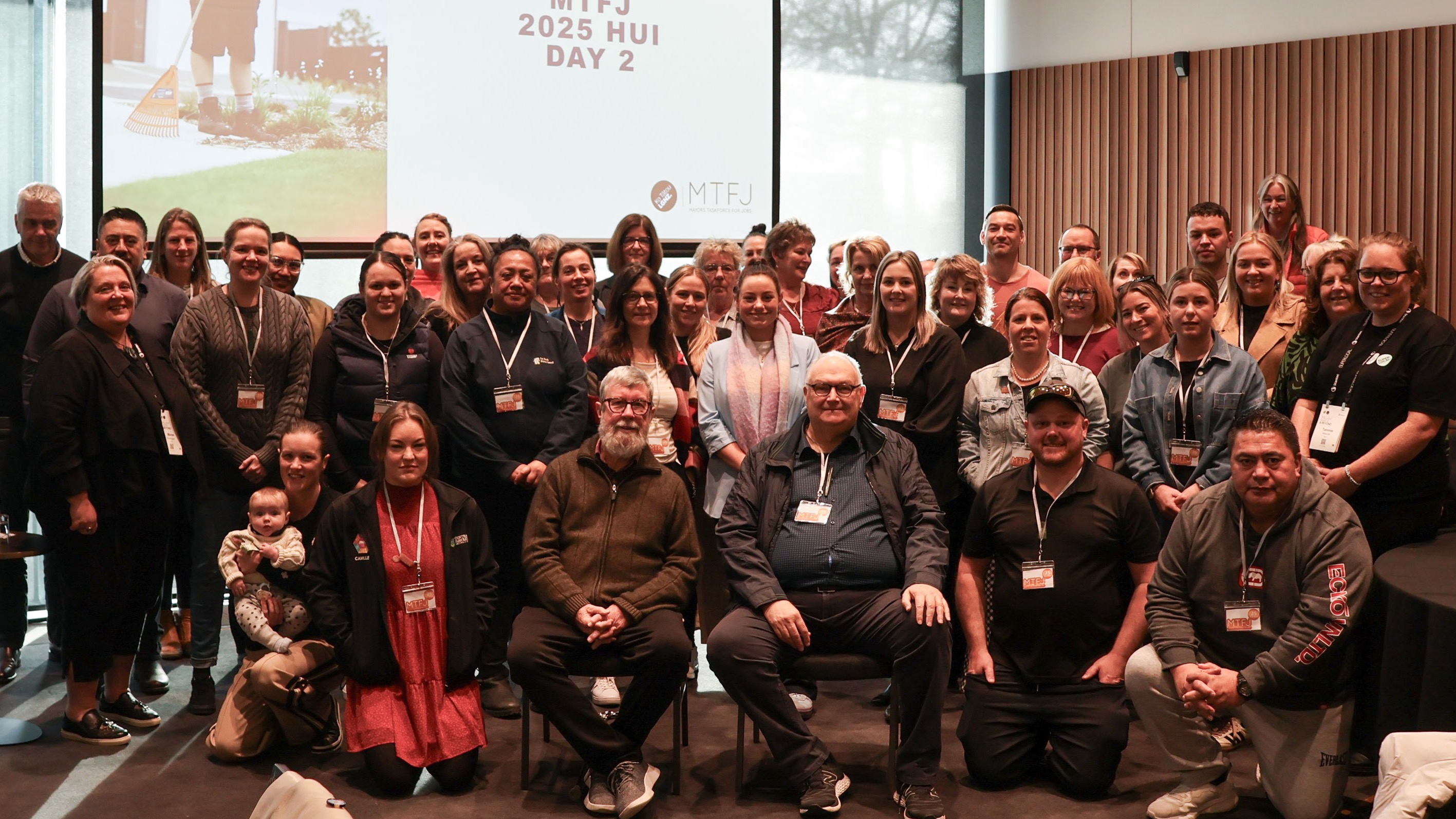
25th Anniversary of the Mayors Taskforce for Jobs. Employment programme managers and supervisors, with Taskforce founding chairman and former Christchurch Mayor Garry Moore, and former Taskforce community advisor vivian Hutchinson, photographed at Te Pae Christchurch Convention Centre 17th July 2025.
IN JULY 2025, at the Local Government Conference in Christchurch, Garry Moore and I met with managers and supervisors who were running various employment programmes and vocational courses under the Mayors Taskforce for Jobs.
These programmes are being run in 36 cities and districts all over the country, and are a testament to the leadership and persistence shown by various Mayors and local government officials who don’t want to be leaders of any place that has no practical use for a large number of its own young people.
After all, anyone with a longer-term perspective knows that young people tend to get older. The youth of today are the ratepayers, and voters, and citizens and community-builders of a future that we will all be sharing together.
This is why there isn’t a family in any town or city in this nation that is raising its own children to be unemployed. We are raising our children to find their way to the good work that needs to be done.
But if we leave the pursuit of full employment just to national politicians and government departments and their contractors, then all we’ll get is a juggling of unemployment with the rates of inflation, and tax cuts for the wealthy that we can’t afford. All this will be paid for with the lives of members of our own families, or anyone else who is leading a vulnerable and precarious existence amidst an economic system that is no longer bothering to care about them.
✽ ✽ ✽
JUST KEEPING ANY employment programme viable in this day and age is no easy task. These Mayors Taskforce initiatives are constantly searching for sufficient funding, and for the political and bureaucratic support and partnerships that will ensure that they can see their way to keep on operating for yet another year.
I know this work, because that is what I was doing for two decades before we started the Mayors Taskforce. I was one of the people who created the Taranaki Work Trust in the 80s and 90s, and we had hundreds of young people and dozens of programmes on our books.
I also started the first work scheme in New Zealand that taught the skills of enterprise to unemployed people, so that they could start their own businesses. This programme was copied and shared with many other communities throughout New Zealand.
All of these home-grown community initiatives were eventually closed down, one after another, thanks to the austerity measures brought in by various neoliberal administrations.
In such a climate, our communities could not achieve any genuine political, or bureaucratic, or even philanthropic partnerships that were capable of ensuring that these initiatives could learn and mature into their necessary service to future generations.
✽ ✽ ✽
MAX RASHBROOKE and the IDEA Think Tank have released an independent report on the state of jobs and workforce planning in New Zealand.
This report doesn’t so much focus on the 156,000 people (5.1%, or one-in-twenty working-age New Zealanders) who appear on our official unemployment statistics. It looks at the much-larger number of 400,000 people (12.3%, or one-in-eight working-age New Zealanders) which includes other definitions of the “jobless”, as well as those people who are in a job but “want more hours”, usually because they are struggling to make ends meet.
The fact that there is not a consistent public outrage at these figures is itself part of the problem. The public willingness to accept such a high level of actual unemployment (regardless of how they are being counted) could possibly be an outcome that is one of the darker arts of current political management.
I’m old enough to remember that our first modern work schemes were created at a time when just 50,000 officially unemployed people was considered a national emergency.
The IDEA report also points out that the amount being spent on training and support measures for the unemployed in New Zealand is about half of that being spent by our major trading partners in the OECD.
There we have it: this collective level of disinvestment in the real needs of our young and unemployed is just shameful.
After two decades of our communities “tightening our belts”, we are well past the time when we need to regain the political commitment to ensure that all our young people can breathe and stretch into the good work they deserve.
vivian Hutchinson is an active citizen living in Taranaki. He was formerly the Community Advisor to the New Zealand Mayors Taskforce for Jobs, and the founding editor of The Jobs Letter. He is the author of How Communities Awaken (2021) and one of the creators of Tū Tangata Whenua - a Masterclass for Active Citizenship.